The Glass Carpet
A novel by
Marjorie Cardwell
A young woman’s lifelong devotion to a dancer brings unexpected adventure, tragedy and love.
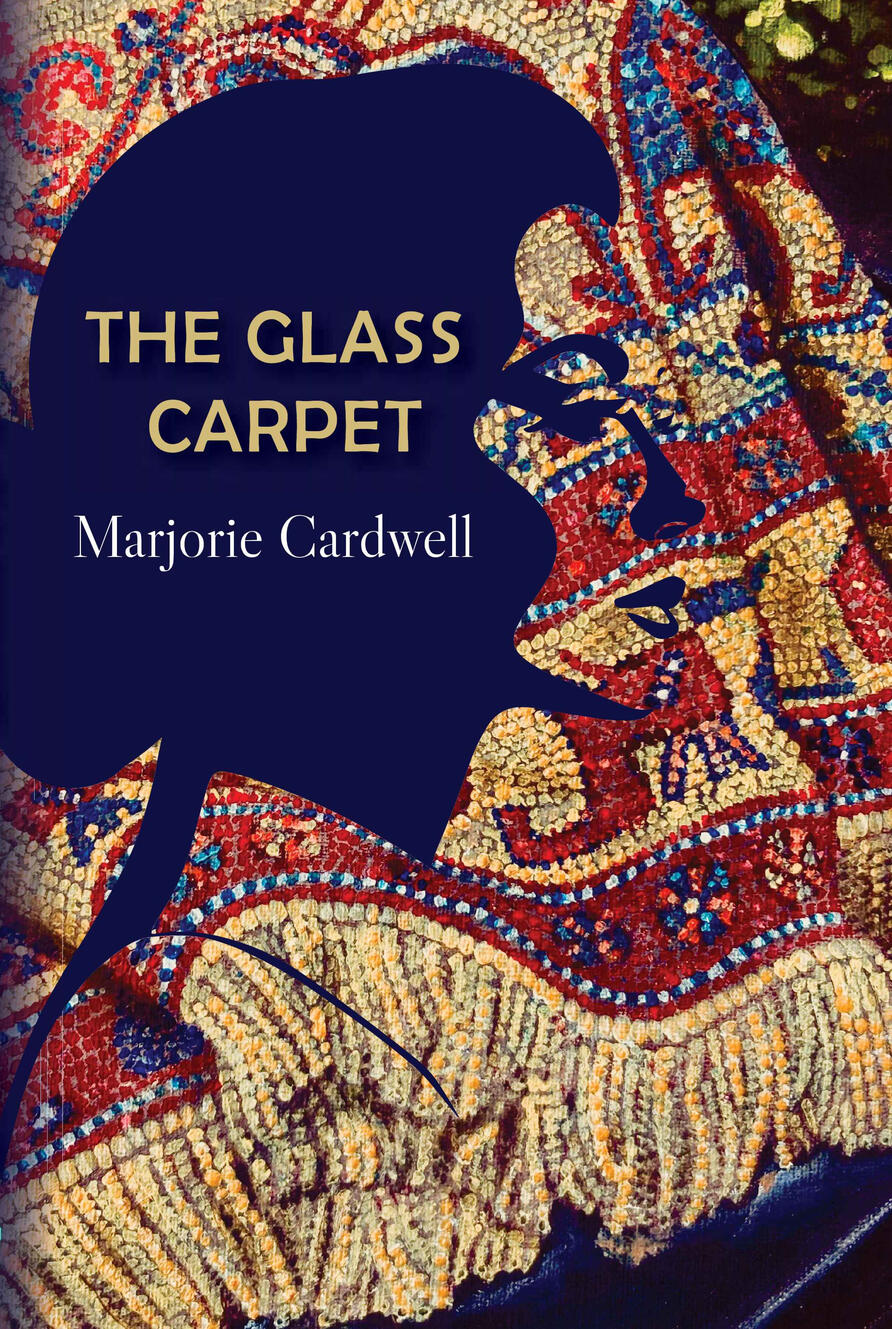

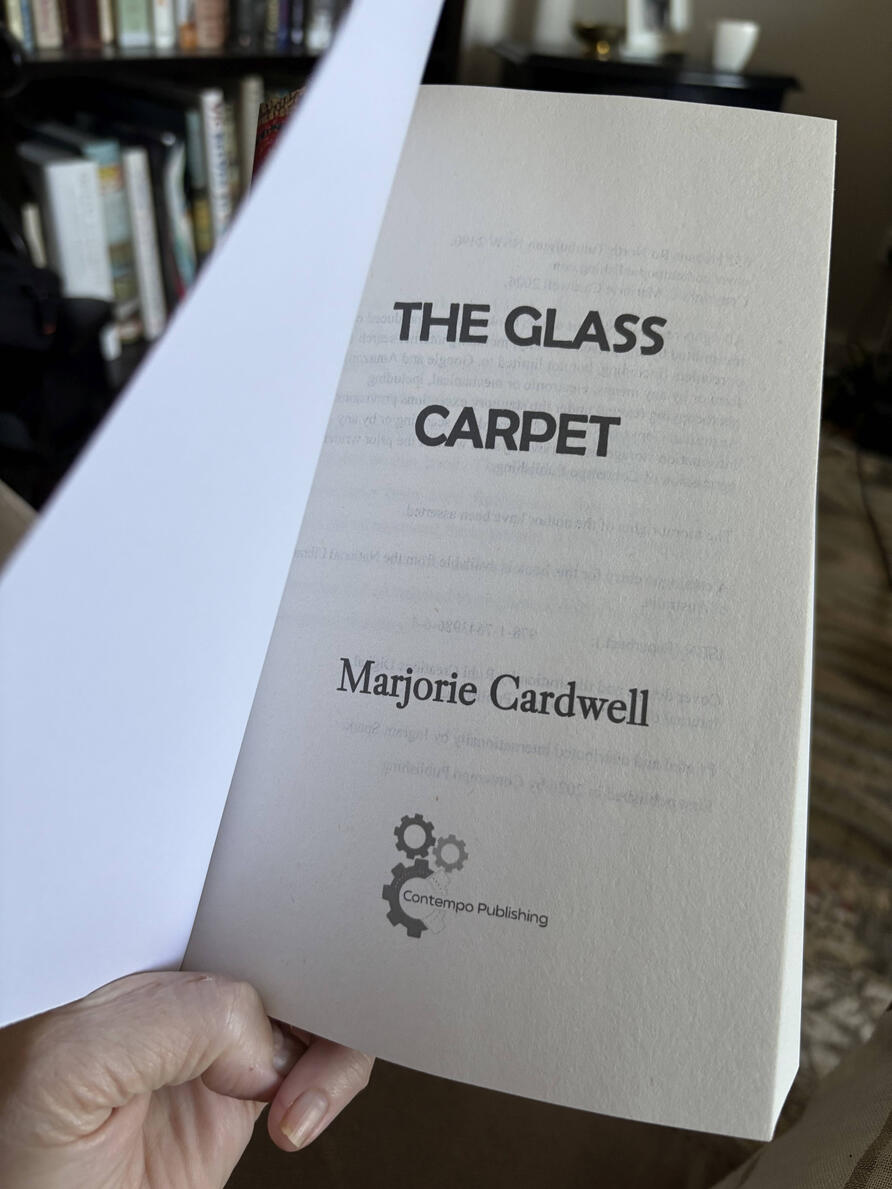
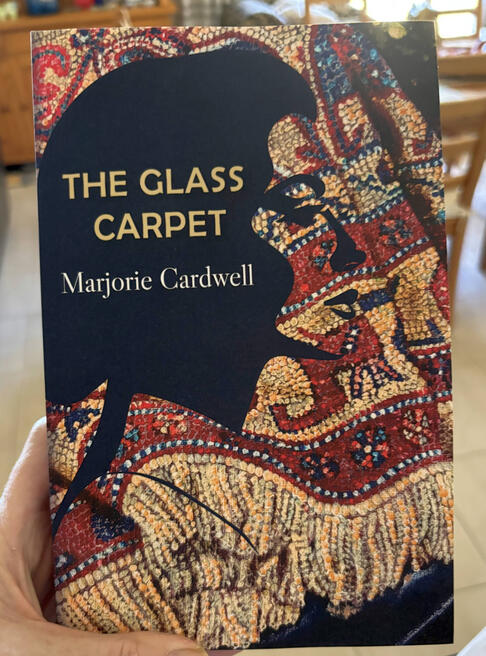
Dinah is a fan. From as long as she can remember she has been obsessed by ballet and is in love with its superstar, Rudolf Nureyev. Her devotion is the one thing people remember about her, because otherwise, she is small, quiet and quite unremarkable. Dinah is anonymous and so she is just the woman for Pavel - the exuberant Soviet official with a taste for silk ties and the arts, who finds himself working as an unlikely double agent in 1970s Australia.'The Glass Carpet' weaves recognisable tales of love and family through the real life politics and prejudices that conspire to jeopardise ordinary people’s hopes and dreams. Dinah’s saga moves from Ireland to Australia, the USSR and France, and is punctuated by encounters with her dancing hero which seem to have magical effects on her life and the lives of those around her. Funny, tragic and moving, 'The Glass Carpet' ultimately reveals that everyone is remarkable, whether they realise it or not.Set throughout the latter half of the twentieth century, 'The Glass Carpet' is a novel about the impact of tradition, politics and genius on the lives of ordinary people and how sometimes devotion is rewarded, even if it takes a lifetime.
ABOUT THE AUTHOR

Marjorie Cardwell is an Irish-born Tasmanian writer whose first novel 'The Glass Carpet' draws on her passion for the Arts and love of spy stories. Marjorie is a former Creative Writing, English and Media Studies teacher, and as well as seeing her first book in print, she is fulfilling another of her lifetime ambitions by pursuing a Fine Arts degree at the University of Tasmania. One of her paintings is featured on the cover of 'The Glass Carpet'.
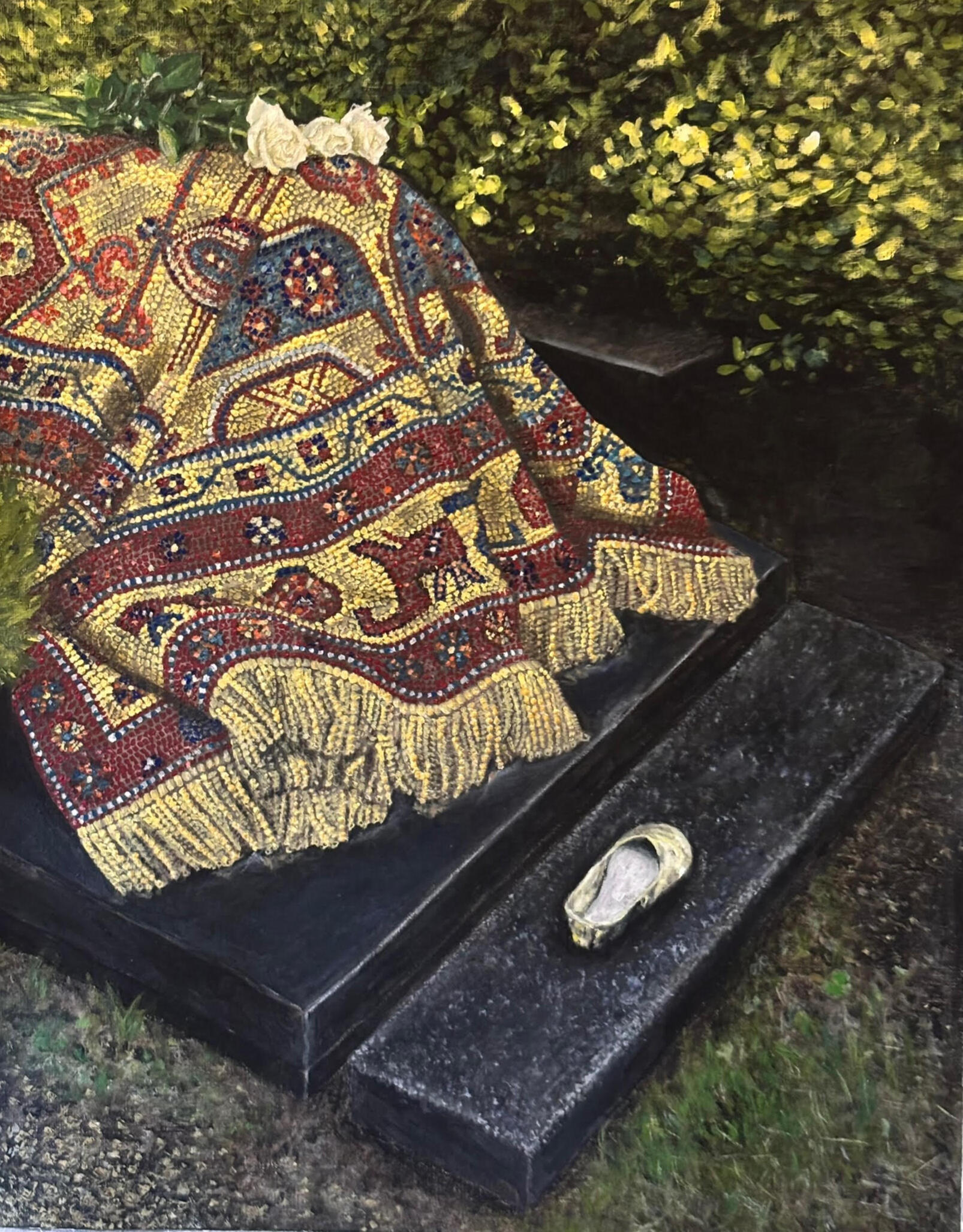
Marjorie Cardwell, "Nureyev's Grave" (2025), acrylics on paper, 29x42cm
How to buy
The Glass Carpet
'The Glass Carpet' is available directly from this website now as a paperback. You can order it below. It's also available from all major online book retailers.
Please allow up to one week for handling of print books plus delivery time to your country. Books are distributed from warehouses in Australia, UK and USA. If you have any questions, please contact us at:
~ Paperback: $29.95 AUD plus $10.00 AUD flat rate shipping worldwide*
The paperback and eBook are also available from Amazon.You can also ask your local bookshop to order you a copy of the paperback.
Just quote ISBN 978-1-7643986-6-4Now available from Petrarch's Bookshop in Launceston, Tasmania.
*Our distributor sends our paperback to most countries in the world. However, there are a few exceptions, e.g. Russia, Belarus, Cuba, North Korea. Readers in countries that we can't ship the print book to should still be able to buy the eBook at Amazon, or try your usual online book seller.

© Marjorie Cardwell. All rights reserved.
Thank you for your purchase!
Please read the instructions below, and then click the download button.
The file will download to your device (usually in your Downloads folder).
HOW TO OPEN YOUR eBOOK* iPhone / iPad: Tap the file, then share → “Books”
* Android: Open the file in Google Play Books or ReadEra
* Computer: Open with Apple Books, Calibre, or Adobe Digital Editions
* Kindle Device: Use “Send to Kindle” to add the fileIf you're unsure, see the detailed instructions below.
## DETAILED INSTRUCTIONSAfter downloading, open the file on your device:### 📱 iPhone / iPad1. Tap the downloaded file in your downloads folder
2. Tap the Share icon (square with arrow) 📤
3. Select Books---### 🤖 Android1. Open your Files or Downloads app
2. Tap the .epub file
3. Choose Google Play Books or ReadEra---### 💻 Mac / Windows1. Open your Downloads folder
2. Double-click the fileIf it doesn’t open:* Install Calibre (free), or
* Install Adobe Digital Editions---### 📖 Kindle (important)EPUB files don’t open directly in the Kindle app.To read on Kindle:1. Go to Send to Kindle
2. Upload the .epub file
3. It will appear in your Kindle library---### If you get stuck* Make sure the file finished downloading
* Try opening it from inside the app (not the browser)
* Or contact us at the following email address and we’ll help:

Thank you for your purchase!

CHAPTER 1 - MORTIFICATION
“Is she dead?”“In this weather? She must be! What will we do? What if she has a gun?”“What can she do with a gun if she’s dead?” said Masha. She had always been the more practical of the two elderly Chislova sisters, now frozen mid-step in the French January chill some forty paces from the bizarre visitation that was stretching their eyesight, courage and sense.“She mightn’t be. Oh, I don’t know what to do, sister, I’m frightened.”“You’re always frightened.”“Well, you go and look then.”“No, you go, Vasha, I’m not getting involved.”“Masha, you are heartless. Oh! But what if she’s a sylph?” Vasha was too fond of stories - her sister had told her so often enough.“Don’t be ridiculous, you silly woman!”The Chislovas were making their first monthly pilgrimage of the year to their grandfather’s grave in the Orthodox cemetery outside Paris, which was the final resting place of so many other Russian émigrés. Some were refugees who had fled the Revolution with little but their pride and (with luck) a few exquisite jewels sewn into their clothing, and now some of their descendants were also in this cold ground. In their midst rested a dissident; the first great defector, the humblest at birth and the grandest at death of them all, Rudolf Nureyev.His grave was a jewel. A magic carpet draped over an invisible tomb. A kilim of gold, red, blue, black and turquoise glass mosaic, gold-fringed and glittering in the watery winter afternoon light. It rested on a black granite slab with his name and years of birth and death, also golden, written in French and Russian. His only epitaph was his occupation, ‘dancer and choreographer.’ The monument was not vulgar, although it could have been. It was just too beautiful - like him. A second black granite slab at the foot of the glittering glass carpet was customarily strewn with gifts from those who had loved him in life and those who still did in death - flowers, ballet shoes and photographs, and notes addressed to his bones.But today it was none of these that was exercising the imagination of the Sisters Chislova. For on this second slab, prostrate and splayed, like a human sacrifice, was a small, pale woman in a foolish red summer dress, legs glowing like turquoise through thin black stockings, bare arms freezing neon blue, as though her body was compelled to coordinate with the gorgeous, gaudy grave. Whether it was a murderer, victim, wraith or waif, Masha and Vasha chose dithering and bickering over the urge to investigate more closely. As they were vacillating, a priest - their priest - materialised out of thin air (that’s how Vasha remembered it anyhow) and was confronted with the same bizarre apparition that had so spooked the sisters.Had they discovered their courage, Masha and Vasha would have also discovered that the apparition wasn’t dangerous, or dead for that matter, although she was cold and oblivious to everything but her own grief, which was now pouring out in exhausted rasps:“Pasha … Pasha … Pasha …” It was not much more than a whisper but enough to prove life.“Daughter,” said the priest in Russian. The woman remained focused on her mission of misery. On closer inspection, she was older than he had first assumed. “Madame,” he tried again in French, placing a hand on her bare and freezing shoulder.She stopped her keening with a start. Turning her head, she saw the figure of Father Anatoly dressed in black from head to toe and she screamed an oath in English. And it was in that language the priest, unfazed, replied:“Dear lady, you are cold, please come now. You can get warm at my house. My housekeeper is there.” Father Anatoly’s words were kind and strongly accented in Russian. The two things combined to bring Dinah McGowan (for that was the sylph’s name) to her senses. She shivered wildly as the priest gently helped her up and placed his long black overcoat around her. He had become used to seeing the dancer’s devotees leaving gifts, shedding tears and taking photographs at his resting place. But this was one that might warrant its own chapter in his memoir. He didn’t notice her own black coat and bag strewn over a third slab of black granite which formed a bench seat beside the tomb.Dinah soon found herself sitting by the fireplace in Father Anatoly’s nearby home, drinking sweet tea under the benevolent glare of his gold, red and black painted icons and his housekeeper, Claire, who was fussing and tutting and saying that no man was worth dying for, especially when he was already dead. She spoke in French, though, so Dinah didn’t really hear anything.“My child,” Father Anatoly eventually offered, “you have a great love for our wayward son, Rudolf?”“Yes,” said Dinah, unable to elaborate or explain why or how she had found herself abandoning a lifetime’s reserve at the sight of his tomb to fling herself towards it as though it were his funeral pyre.“But you weren’t saying his name, were you?”Dinah was silent.“Who is Pasha, daughter?”She almost told him until Secrecy, her judge and jailer for the past twenty years, reminded her of her duty.“No one,” she said and cast her eyes downward out of the range of the assembled saints.Dinah was thoroughly mortified. She had made avoiding scrutiny her life’s work and she wasn’t given to spontaneity as a rule. And now what she had thought was a well-devised journey from Australia to see her daughter and parents on the other side of the world in Ireland (with a side trip to the grave of her hero in France) had ended in disaster because she had betrayed her nature. The visit had hardly been a success before that anyway. It was meant to be a surprise, but her heart and stomach sank when she discovered that Anna, her daughter, had gone back to college in England. Her parents reminded her that Anna didn’t have long Christmas holidays like they did in Australia and Dinah felt like an idiot. It was also clear that her mother and father were more shocked than delighted to see her after years of absence. Conversations were brief, strained and punctuated with long, uncomfortable silences. It was easier in letters and on the phone. They couldn’t see her face to know when she was lying. She was going to cut short the agony by visiting her daughter in England. She had hoped to be Anna’s friend in adulthood. But when Dinah phoned her, they could hardly think of a thing to say to each other either, and she let the idea die. She would only have embarrassed Anna in front of her friends anyway. So, she went to France and disgraced herself in front of strangers instead. Shame followed her. She should have known that by now.Dinah had been looking forward to seeing where Rudolf was buried. It wasn’t ghoulishness; it was the right thing to do now that she had, she thought, got over the shock of his death. But that tomb had been too much. His skeleton lying six feet below her was too much. She loved him too much. She threw off her coat and threw herself down before the magic glass carpet in something like a trance. And great though her grief for him was, it grew to be even bigger. It was for all her loss: her family, her motherhood and above all, her Pasha. At least she knew where her family was. At least she knew where Rudolf was, his bones at least. But where were Pasha’s bones?Her coat. Her bag! Where was her bag? It had her inhaler. Her money. Her tickets. Her passport. ‘Stupid! Stupid! Stupid!’ she thought, but didn’t say it. Her kindly but foreboding rescuers watched as the colour that had finally begun to return to her face drained away again. Her dark eyes became ghastly as their lids drew back with fear and her shivering resumed with renewed vigour.“My child, what is it that troubles you?” said Father Anatoly quietly and with such warmth that it melted Dinah’s gathering composure.“I’ve lost my coat and my bag with all my things,” Dinah whispered between sniffles, desperately embarrassed now.Father Anatoly did not need to tell Claire what he intended to do. After twenty years she could read him like a book. She knew that the housekeeping money was about to be short for another week and she was going to lose the new coat he had given her as this year’s Christmas present. Again.“I’ll fetch the coat,” she said in French as she trudged to her room.“Thank you, Claire. You will be repaid,” said Anatoly ruefully, because he knew it wouldn’t be in this lifetime. The painted saints looked on in solemn approval.Or were they praying? Because at that moment, two unlikely angels knocked at the door. Masha and Vasha had retrieved Dinah’s coat and bag from the graveside and after the usual round of dithering, had walked with them to the priest’s house in the hope of a heavenly absolution for their earlier inaction and perhaps a glass of tea and some of Claire’s cake to seal the deal. Finding out the gossip about the foreign wretch would be a bonus.“I’ll get it,” Father Anatoly called upstairs to his housekeeper who was taking one last look at her new green woollen coat with a sigh of resignation.“Ladies! This is a cold day for you to be walking so far. What can I do for you?” Father Anatoly touched the door to the sitting room closed with his toe as he spoke.“We have her coat.” said Masha offering the black quilted garment.“And her bag! Her bag too, Father,” said Vasha rather more breathlessly. “We haven’t looked inside it,” she added and received a dig in the ribs from her sister for it.“Oh daughters, you will receive a blessing for this. You must come to lunch on Sunday – mustn’t they, Claire?”Claire was watching from the top of the stairs. God had answered her selfish prayer and let her keep her new coat. And it was as well they weren’t giving away the housekeeping money, now that she had two extra mouths to feed for Sunday lunch.“Yes of course. All are welcome at Father Anatoly’s table,” she said with rather more readable subtext than she had intended.Masha and Vasha stood their ground, still hoping for a more immediate invitation and craning around the priest for a glimpse of Vasha’s sylph. When a stalemate became apparent, they left with the Father’s thanks and their assurance that they would bring something for dessert on Sunday. As they scuttled home their mutterings were more bitter than sweet.Dinah was so grateful to see her bag and coat, she let out a huge laugh which made Father Anatoly beam, Claire scowl and Dinah flush as red as her dress. True to the babushkas’ word, the contents of her bag were undisturbed. Somehow, she hadn’t needed her inhaler throughout the whole debacle. A small mercy.* * *
In her hotel room, Dinah packed the red dress. It had been a quixotic notion to wear it to the grave. She was wearing it the last time she spoke to Rudolf, not long before he died. She also wore it for him when it was newly made, more than twenty years ago, and she was sure he had liked it. Vasha Chislova wasn’t so far off the mark because Dinah had maintained her sylph-like figure all her life and so the fit of the dress wasn’t a problem. The style wasn’t either. Such a simple dress was never really in or out of fashion. It suited her very well. It did not suit a bitter French winter.Dinah was returning to an Australian summer – a Melbourne summer. The dress would have matched the blanket of red dust that came in on the hot winds that brought with them their seasonal reminder that the city was not European, despite all its efforts, and despite the claim that the red earth and its people had never relinquished. But she still had to get to the airport, and January in Paris was more brutal than she had imagined when she packed for her ill-conceived last-minute tilt at mothering. So, Dinah created an outfit of incongruous layers and made the long journey home to her empty unit, her regrets and her jerry-rigged air conditioner of a fan and a basin of water.
Join my mailing list for occasional updates.
We’ll only use your email for updates. You can unsubscribe anytime.